
Calm Parenting Tools That Actually Work (And When to Use Them)
Calming tools for kids at home work best when introduced before or at the first signs of overwhelm — not during a full meltdown. Tools like sensory swings, fidgets, and weighted blankets support regulation when practiced in calm moments and used proactively rather than as consequences.
Calm Parenting Tools That Actually Work
You bought the sensory swing.
You ordered the fidget kit.
There’s a calm-down corner with a beanbag and soft lights.
And somehow… meltdowns are still happening.
If you’ve invested in calming tools for kids at home and feel unsure whether you’re using them “right,” you’re not alone. Many parents don’t need more tools. They need better timing, clearer strategy, and permission to stop guessing.
Let’s talk about what actually works.

Tools Don’t Calm Kids. Regulation Does.
Here’s the quiet truth: a tool is only as effective as the nervous system using it.
A weighted blanket won’t help a child who is already in full fight-or-flight. A breathing card won’t land when emotions are at a 10.
Calming tools for kids at home work best before escalation or during early signs of overwhelm, not at the peak of distress.
Think of tools like umbrellas.
They help in rain.
They don’t stop the storm.
Why So Many Tools Go Unused
Parents often buy tools in moments of hope. They imagine smoother transitions, calmer evenings, fewer power struggles.
But without a plan, tools become:
Decorative
Forgotten
Or introduced in the heat of the moment
When a child is already dysregulated, their thinking brain is offline. They can’t access strategies they haven’t practiced in calm moments.
This is where many families get stuck. Not because the tool is wrong, but because the introduction timing is.
The Three Categories of Calming Tools (And When to Use Them)
Not all calming tools for kids at home serve the same purpose.
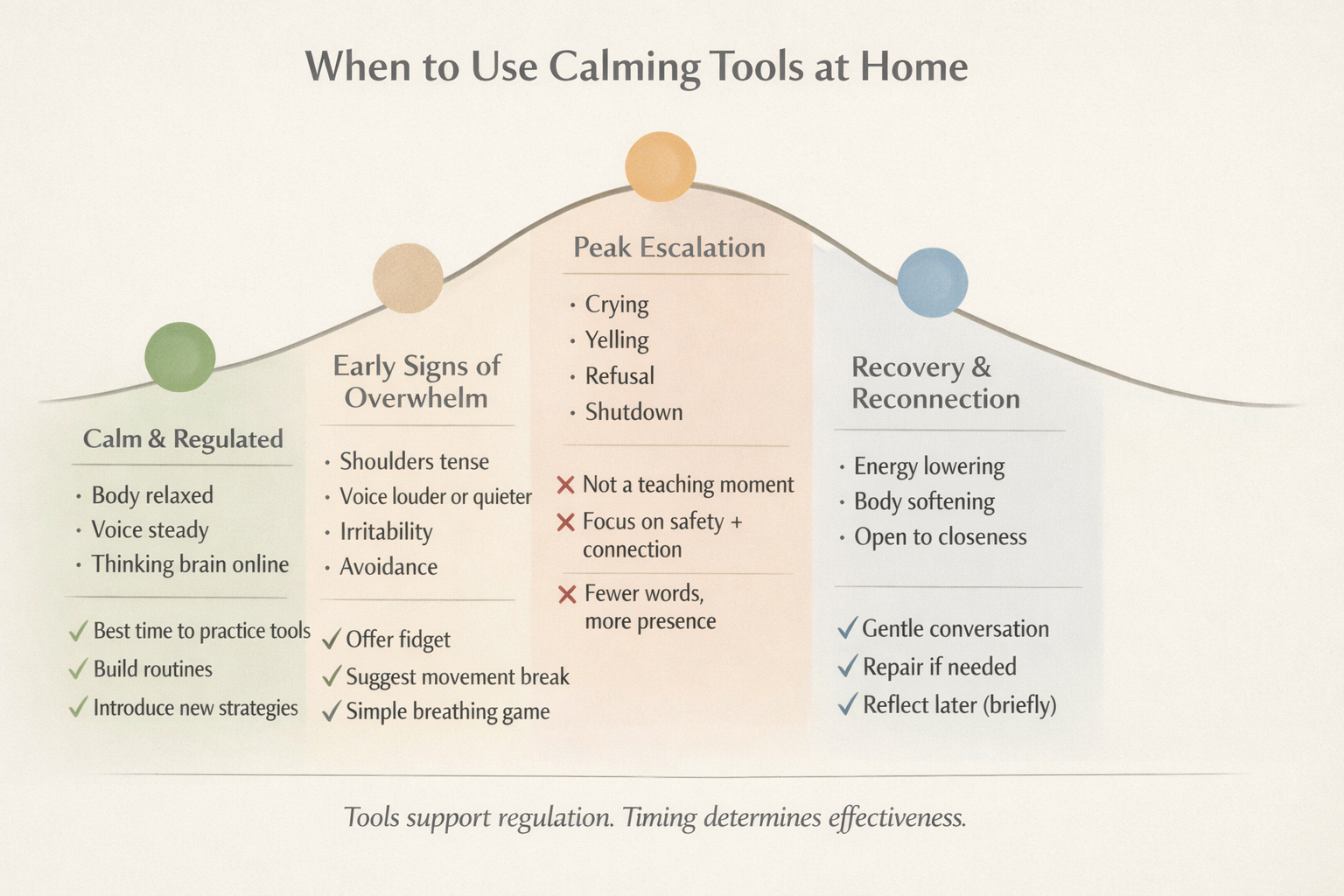
1. Preventative Tools (Use During Calm)
These build regulation capacity over time.
Examples:
Sensory swings
Heavy work activities (pushing, pulling, carrying)
Scheduled quiet time
Predictable routines
Use these proactively, not as consequences.
They are nervous system maintenance, not emergency response.
2. Early-Stage Tools (Use at First Signs of Frustration)
These work when a child is starting to show cues like:
Clenched fists
Irritability
Withdrawal
Faster speech
Examples:
Fidgets
Chewy tools
Short breathing games
A movement break
At this stage, the child still has access to choice.
Timing matters more than perfection.
3. Recovery Tools (After the Storm)
Once emotions peak, the goal shifts from “calming down” to reconnecting and settling.
Examples:
Sitting together quietly
Rocking
Soft music
Warm shower
Gentle pressure (if welcomed)
During full escalation, fewer words are better.
Connection first. Teaching later.

Practical Examples: What This Looks Like at Home
Let’s bring this into real life:
Scenario 1: Homework frustration
Instead of:
“Go sit in your calm corner.”
Try:
“I’m noticing your shoulders getting tight. Want to squeeze your stress ball for a minute?”
Small shift. Big difference.
Scenario 2: Bedtime resistance
Instead of introducing a weighted blanket mid-meltdown, build it into routine:
“After pajamas, we’ll snuggle under your heavy blanket while we read.”
Predictability lowers resistance.
Scenario 3: Sibling conflict escalating
Catch it earlier:
“I see voices getting louder. Let’s pause and do 10 wall pushes.”
Early intervention prevents power struggles.
A Gentle Do / Don’t List
Do:
Introduce tools during calm moments
Practice when nothing is “wrong”
Model using tools yourself
Keep language simple
Notice early body signals
Don’t:
Introduce tools as punishment
Wait until emotions are at a 10
Over-explain during a meltdown
Expect instant results
Buy more tools instead of refining use
Often, families don’t need a new Amazon order.
They need a clearer rhythm.
The Skepticism Makes Sense
If you’ve tried tool after tool and feel tired of experimenting, that fatigue is real.
It’s discouraging to invest time, money, and energy into something that doesn’t shift the dynamic.
But the missing piece usually isn’t effort.
It’s nervous system awareness.
When parents understand how regulation unfolds, and how to respond earlier, the same tools often start working.
Not because the child changed overnight.
But because the timing did.
When to Get More Support
If calming tools for kids at home feel inconsistent or confusing, it may help to explore patterns with a therapist trained in nervous system regulation.
Sometimes the real intervention isn’t the object.
It’s the relationship pattern around it.
And that’s where sustainable change begins.
FAQ
-
During intense emotions, a child’s thinking brain is less accessible, making it harder to use strategies effectively.
-
A few well-practiced tools used consistently are more effective than many unused items.
-
No. All children benefit from learning emotional regulation skills.
This article is for educational purposes only and does not replace individualized mental health care. If you are experiencing severe distress or thoughts of harming yourself, please seek immediate professional support.
Many emotional regulation strategies are aligned with guidance from organizations such as the American Academy of Pediatrics and the American Psychological Association.
